Tuesday, April 23, 2013

Caves and Cave Art of Primordial People

To primitive humans, caves were sacred places. 


People lived around or inside the entrance of a cave, but ventured deeper into the cave for religious or magical purposes.


Animal paintings on the walls of caves may have been primitive man's way of connecting with their spiritual qualities. 



Boys were taken into the caves to be initiated as hunters. 


A rite that probably involved a symbolic death and rebirth deep within a dimly lit, womb-like cave surrounded by animal images.


To early humans a cave symbolized the leaving of everyday reality. 

As they went inside to find where their deeper nature-connected deities and went to honor the spirits of other animals.


Many early cave paintings, such as those of the Trois Frères cavern, in southern France, depict beings who are part-animal and part-human in form. 


A bearded male figure, with ears of a bull, antlers and a horse's tail, may have represented either a divinity or a magician.


It is difficult to differentiate between images of human magicians and divine figures in Paleolithic art, as both appear to share this mixture of human and animal features. 


The magician was an important member of the community  and was probably considered a god in human form, with influence upon the gods and animal spirits. 


Wednesday, April 17, 2013

Primordial Fire

The ability to make fire and harness its energy was a highly significant development, achieved by Homo erectus (around 1.6 million - 300,000 BCE), and gave fire important symbolic qualities.


The act of making fire represents the spark of imagination and creativity, and the energy of fire is in itself symbolic of power: harnessing and using nature to control other aspects of the natural world, bringing life-sustaining warmth, and frightening away threatening animals.


Fire enabled people to extend the day after dark, creating a social time around a campfire or hearth, sharing myths and stories.


At this early stage fire also became a symbol of trasformation through the process of cooking.


Tuesday, April 16, 2013

Primordial Signs and Symbols

During the era of Australopithecus (the Australopithecus Africanus (from about  3.6  million BCE) to Homo Sapiens) humans began making tools, learning how to use and make fire, and construct houses.


All of the information we have of our early ancestors comes from archaeological evidence; such as cave paintings, artefacts, and traces of of possible ritual practices.


Evidence of the development of symbol and ritual comes mainly from the Paleolithic people who emerged about two million years ago.


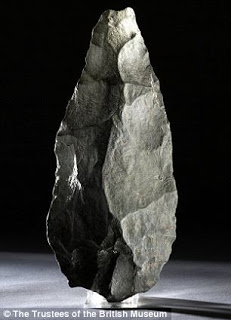
They were mainly hunters, and much of their industry involved working with chipped stone.


At the time, our ancestors started developing language.


With the beginnings of language and the convenience of tools, man had more time to think and create.


This was the dawn of mythology and symbolism.

It meant that people were beginning to relate to concepts deeper than what they had in their daily lives.


It is easy to imagine that their relationship with nature, the seasons and weather, the animals they hunted, the birth of their children and the inevitability of death led them to ponder the events in their lives.


The primitive symbols of the cave, fire, the hand axe, and the representation of animal figures, may have served as foundation metaphors for the complex human mythologies that have subsequently evolved.


The symbols and rituals of primordial human beings may have served to align these people with the rhythms of their bodies, and nature; and to honor the forces influencing them.


MORE ON PRIMORDIAL SIGNS AND SYMBOLS: