Tuesday, April 16, 2013

Primordial Signs and Symbols

During the era of Australopithecus (the Australopithecus Africanus (from about  3.6  million BCE) to Homo Sapiens) humans began making tools, learning how to use and make fire, and construct houses.


All of the information we have of our early ancestors comes from archaeological evidence; such as cave paintings, artefacts, and traces of of possible ritual practices.


Evidence of the development of symbol and ritual comes mainly from the Paleolithic people who emerged about two million years ago.


They were mainly hunters, and much of their industry involved working with chipped stone.
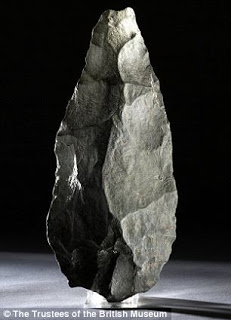


At the time, our ancestors started developing language.


With the beginnings of language and the convenience of tools, man had more time to think and create.


This was the dawn of mythology and symbolism.

It meant that people were beginning to relate to concepts deeper than what they had in their daily lives.


It is easy to imagine that their relationship with nature, the seasons and weather, the animals they hunted, the birth of their children and the inevitability of death led them to ponder the events in their lives.


The primitive symbols of the cave, fire, the hand axe, and the representation of animal figures, may have served as foundation metaphors for the complex human mythologies that have subsequently evolved.


The symbols and rituals of primordial human beings may have served to align these people with the rhythms of their bodies, and nature; and to honor the forces influencing them.


MORE ON PRIMORDIAL SIGNS AND SYMBOLS:


Sunday, April 14, 2013

Introduction to Signs and Symbols Part 2

A sign may be understood as something that stands for or points to something else in a literal way.


A sign conveys information about a curtain topic or idea.


While a symbol is meant to trigger a series of meanings or emotional responses.


As a sign, the word "tree" means a type of plant that has a woody structure, a trunk, branches, leaves, and roots.


While as a symbol it may represent the "tree of life" which links the everyday world and the notion of the spirit world.


Signs and symbols don't have exact meanings, since the same tree could be described in an infinite amount of ways, in different languages and in different cultures.


Signs and symbols derive their meanings from human interaction.


They change throughout different times, evolving as we do.


Friday, April 12, 2013

Introduction to Symbols Part 1

The word "symbol" is derived from the ancient Greek word symballein, meaning to throw together.


Its figurative use originated in the custom of breaking a clay tablet to mark the conclusion of a contract or agreement. 


Each party in the agreement would be given a piece of the brocken tablet, so that when they reconvened the pieces could be put together like a jigsaw puzzle. 


The broken pieces of the of the tablet, that identified the persons in the agreement, were known as symbola. 


So a symbol then came to be known as something that represented something else.


Symbols also represented something missing or an invisible part that is needed in order to complete the whole meaning. 


Whether consciously or unconsciously, symbols carry the sense of joining things together to create a whole greater than the sum of its parts, as shades of meaning accrue to produce a complex idea.